
Introduction
Selecting the right cylindrical grinding machine is an important decision because it directly affects productivity, component quality, consistency and future manufacturing capability.
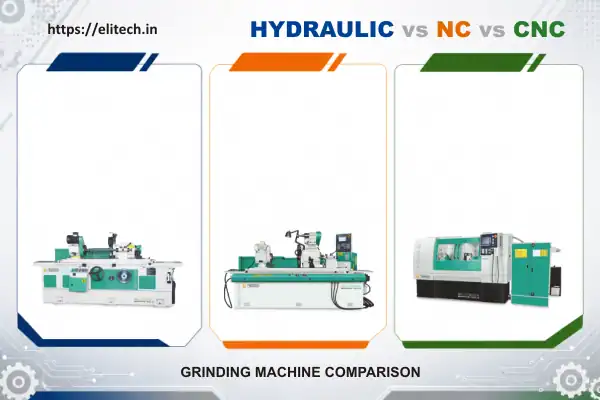
Today, industries commonly choose between Hydraulic, NC and CNC grinding machines based on production requirements, component complexity and automation needs.
Many buyers assume CNC machines automatically provide higher speed and better axis accuracy than NC machines. In practical applications, this is not always true. The actual selection depends on factors such as grinding cycle requirements, component geometry, programming flexibility and operator dependency.
To understand grinding fundamentals, you can also read our guide on What is a Cylindrical Grinding Machine.
Understanding Hydraulic Grinding Machines
Hydraulic grinding machines have been widely used across industries for many years because of their simple operation and lower investment cost.
These machines use hydraulic systems for movement of work table and manual operational control for feeding axis inbuilt with hydraulic rapid approach.
Advantages of Hydraulic Grinding Machines
- Lower initial investment
- Simple operation
- Reliable performance
- Easy maintenance
- Suitable for small production batches and tool-room works
Limitations of Hydraulic Grinding Machines
- High operator dependency
- Increased setup time
- Lower automation level
- Productivity depends on operator experience
Unlike NC and CNC systems, hydraulic grinding machine performance is significantly influenced by operator skill.
Machine performance can vary depending on:
- Job setup accuracy
- Infeed adjustments
- Wheel dressing quality
- Cycle consistency
- Dimensional control
- Surface finish control
Two operators using the same hydraulic machine may achieve different results in productivity and quality.
Hydraulic grinding machines remain suitable for:
- Job work shops
- Tool rooms
- Small engineering companies
- Low production environments
You can explore our Hydraulic Cylindrical Grinding Machine range.
Understanding NC Grinding Machines
NC (Numerical Control) grinding machines operate through pre-programmed instructions and provide a balance between conventional and fully automated systems.
NC grinding machines significantly reduce operator dependency and improve production consistency.
Advantages of NC Grinding Machines
- Better repeatability than hydraulic systems
- Reduced operator dependency
- Higher productivity
- Suitable for medium-scale industries
- Lower investment than CNC systems
Limitations of NC Grinding Machines
- Limited cycle capability
- Limited profile generation
- Reduced flexibility for complex components
For example, an NC cylindrical grinding machine program may support:
- Maximum six straight diameters
- Plunge grinding cycle
- Oscillation grinding cycle
For many standard cylindrical components and shaft applications, these capabilities are sufficient.
NC grinding machines are commonly used in:
- Pump industries
- Auto ancillary companies
- Bearing industries
- General engineering industries
You can explore our NC Grinding Machine range.
Understanding CNC Grinding Machines
CNC (Computer Numerical Control) grinding machines provide complete programming flexibility and advanced grinding capabilities.
Unlike NC machines, CNC systems are not restricted by predefined cycle limitations and can handle highly complex component geometries.
Advantages of CNC Grinding Machines
- Flexible programming capability
- Reduced setup time
- High production consistency
- Minimal operator intervention
- Ability to process complex components
Advanced Capabilities of CNC Grinding Machines
Modern CNC cylindrical grinding machines can perform:
- Multiple diameter cycles
- Complex profile grinding cycles
- Radius grinding
- Taper grinding
- Profile dressing
- Precision radius dressing
CNC systems also allow synchronized axis movement.
Through synchronized two-axis operation, CNC systems can generate:
- Precision radius dressing on grinding wheels
- Complex wheel profiles
- Simultaneous profile generation
This capability allows manufacturers to process complex component profiles that are difficult to generate using standard NC systems.
You can explore our CNC Cylindrical Grinding Machine solutions.
CNC vs Hydraulic vs NC Grinding Machine Comparison
| Feature | Hydraulic | NC | CNC |
|---|---|---|---|
| Automation | Low | Medium | High |
| Operator Dependency | High | Low | Very Low |
| Axis Positioning Accuracy | Good for Feeding Slide | High | High |
| Axis Repeatability | Good for Feeding Slide | High | High |
| Movement Speed | Moderate | High | High |
| Programming Flexibility | N/A. | Moderate | Very High |
| Profile Grinding Capability | No | No | Advanced |
| Dressing Capability | Manual | Auto | Auto |
| Initial Investment | Low | Medium | High |
| Complex Component Capability | Low | Moderate | Excellent |
CNC vs NC: The Difference Is Flexibility and Synchronized Capability
A common misconception is that CNC machines always provide better positioning accuracy and higher movement speed than NC systems.
In practice, for machines designed with similar mechanical structures, servo systems, and feedback systems, both NC and CNC machines can provide similar:
- Axis positioning accuracy
- Axis repeatability accuracy
- Movement speed
The actual difference becomes visible when component complexity increases.
NC Machine Capability
NC systems efficiently handle:
- Straight diameters
- Plunge grinding
- Oscillation grinding
- Standard cylindrical parts
CNC Machine Capability
CNC systems become advantageous for:
- Profile grinding
- Complex geometry generation
- Multiple diameter cycles
- Radius grinding
- Synchronized dressing operations
The advantage of CNC is therefore not simply speed or axis accuracy—it is programming flexibility and synchronized multi-axis capability.
Factors to Consider Before Selecting a Grinding Machine
Before selecting a grinding machine, manufacturers should evaluate:
Production Quantity
Higher production volumes generally justify increased automation.
Component Complexity
Standard shafts and cylindrical parts can be efficiently produced using NC systems.
Complex profiles and special geometries often require CNC capability.
Future Expansion
Businesses expecting future product development should consider machine flexibility.
Long-Term Productivity
Machine selection should consider not only present production requirements but also future manufacturing goals.
Machine structural design also affects performance. Read our article on V-Flat Guideways vs Linear Guideways in Grinding Machines.
Conclusion
Selecting between Hydraulic, NC, and CNC grinding machines should not be based only on machine cost or assumptions about speed.
Hydraulic grinding machines remain effective for low production environments but require greater operator skill for maintaining consistency.
NC grinding machines provide excellent repeatability and productivity for standard cylindrical grinding applications while keeping investment cost under control.
CNC grinding machines become advantageous when manufacturing requires complex profiles, multiple diameter cycles, synchronized wheel dressing, and future production flexibility.
The actual difference between NC and CNC is not simply speed or axis accuracy. It is the capability to handle complex operations and provide greater programming flexibility for advanced manufacturing requirements.
