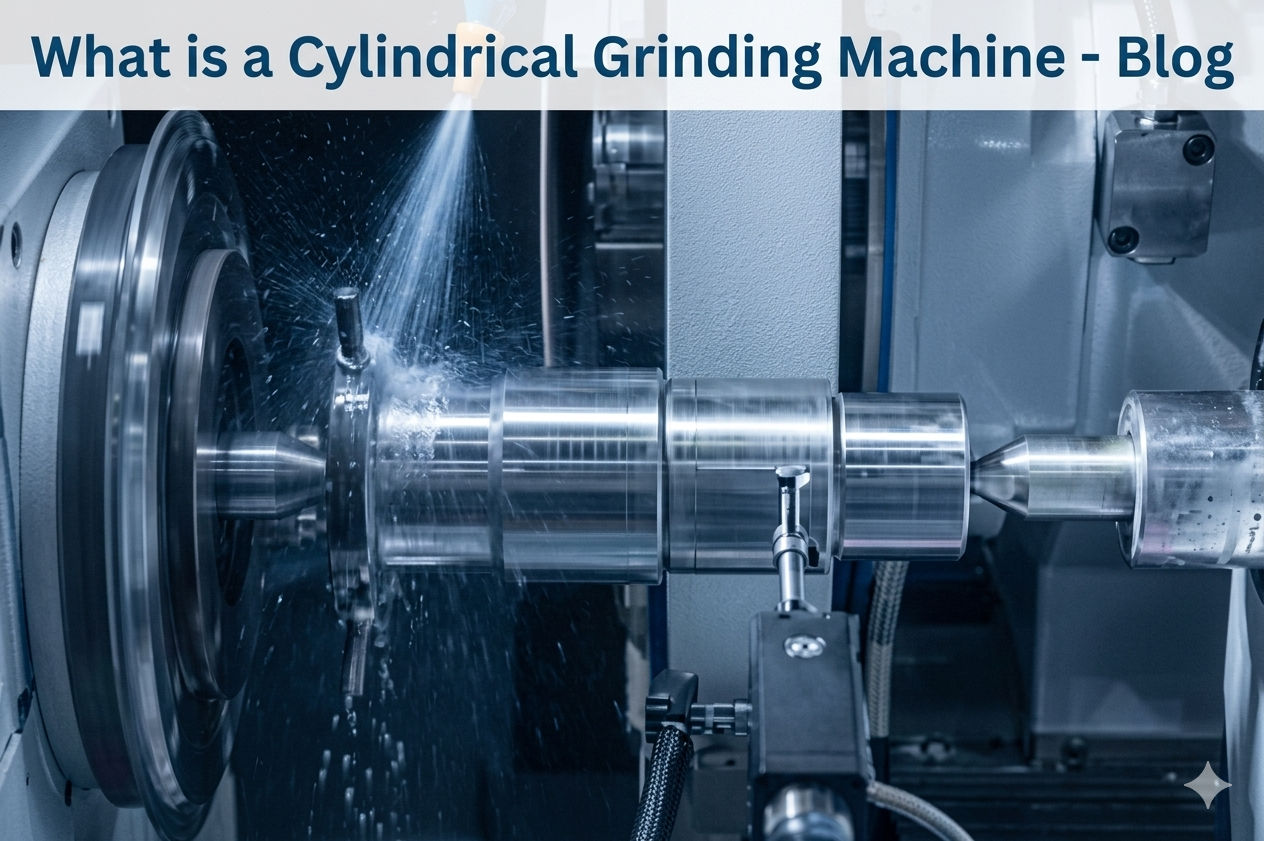
What is Cylindrical Grinding Machine? (Complete Guide)

April – 2026

Introduction

A cylindrical grinding machine is a precision engineering tool used to achieve accurate dimensions and superior surface finishes on cylindrical components. It is widely used in automotive, aerospace, and heavy engineering industries where tight tolerances and consistent quality are essential.

What Is a Cylindrical Grinding Machine?

A cylindrical grinding machine removes material from the outer surface of a rotating workpiece using a high-speed abrasive grinding wheel. It is commonly used to finish components such as:

  • Shafts and rods
  • Bearings
  • Precision-engineered components

Unlike conventional machining processes, cylindrical grinding offers high dimensional accuracy, excellent repeatability, and a fine surface finish.

How Does a Cylindrical Grinding Machine Work?

The working principle involves the following steps:

  1. The workpiece rotates between centers or is held using a suitable workholding arrangement.
  2. The grinding wheel rotates at high speed.
  3. The wheel moves across the workpiece, removing small amounts of material.
  4. Controlled grinding passes achieve the required dimensions and surface finish.

Cylindrical grinding is a type of abrasive machining process used for precision finishing.

Key Components

A typical cylindrical grinding machine consists of:

  • Grinding wheel: Removes material from the workpiece.
  • Workhead: Holds and rotates the workpiece.
  • Tailstock: Supports the workpiece during grinding.
  • Machine bed: Provides structural stability and alignment.
  • Wheel head: Supports and drives the grinding wheel.
  • Control system: Enables manual, NC, or CNC operation.

Types of Cylindrical Grinding Machines

Hydraulic Cylindrical Grinding Machine

  • Simple operation and maintenance
  • Cost-effective for conventional grinding requirements
  • Suitable for small-scale industries and general-purpose applications

Explore: Hydraulic Cylindrical Grinding Machine

NC Cylindrical Grinding Machine

  • Offers numerical control for improved process consistency
  • Reduces manual intervention
  • Suitable for medium-volume production

Explore: NC Grinding Machine

CNC Cylindrical Grinding Machine

  • Provides automated and programmable grinding operations
  • Delivers high precision and repeatability
  • Ideal for complex components and high-volume production

Explore: CNC Cylindrical Grinding Machine

Advantages of Cylindrical Grinding

  • High dimensional accuracy
  • Excellent surface finish
  • Consistent production quality
  • Reduced manual errors
  • Suitability for batch and mass production

Industrial Applications

Cylindrical grinding machines are commonly used in:

  • Automotive manufacturing
  • Aerospace engineering
  • Tool and die manufacturing
  • Heavy engineering
  • Railway component manufacturing

Read more: Applications of Cylindrical Grinding Machine

Availability Across Industrial Cities

Elitech Machine Tools serves manufacturing hubs across India, including:

  • Ahmedabad
  • Pune
  • Coimbatore
  • Chennai
  • Bengaluru

Visit our city pages to learn more about machine availability and local support.

How to Choose the Right Cylindrical Grinding Machine

Consider the following factors when selecting a machine:

  • Production volume: Choose a model that meets your manufacturing requirements.
  • Required accuracy: Evaluate the dimensional tolerances and surface finish needed.
  • Budget: Consider the initial investment and long-term operating costs.
  • Automation level: Select hydraulic, NC, or CNC control based on your production needs.

Also read:

  • CNC vs Hydraulic vs NC Grinding Machine
  • How to Choose a Grinding Machine

Conclusion

A cylindrical grinding machine helps manufacturers achieve precise dimensions, consistent quality, and superior surface finishes. Selecting the right hydraulic, NC, or CNC model depends on your application, production volume, and accuracy requirements.

Looking for the Right Grinding Solution?

Contact Elitech Machine Tools for expert guidance and customized machine recommendations to suit your manufacturing needs.

Frequently Asked Questions

Q1. What is a cylindrical grinding machine used for?

It is used to grind and finish cylindrical components, such as shafts, rods, and bearings, with high dimensional accuracy.

Q2. Which type of cylindrical grinding machine is best for production?

CNC cylindrical grinding machines are generally suitable for high-volume production requiring precision, repeatability, and automation.

Q3. Which industries use cylindrical grinding machines?

They are widely used in automotive, aerospace, railway, tool and die, and heavy engineering industries.
 

CBN vs Diamond Grinding Wheel: Complete Comparison & Applications

April – 2025

Choosing the right grinding wheel is critical for achieving high precision, longer tool life, and superior surface finish. Additionally, selecting the correct wheel improves overall grinding efficiency and consistency. Therefore, selecting the right grinding machine plays a key role in achieving optimal results.

At Elitech Machine Tools, our advanced grinding solutions are designed to deliver optimal performance with the right wheel selection for every application. This guide will help you understand the difference between CBN and diamond grinding wheels and how to choose the right one.

What is a CBN Grinding Wheel?

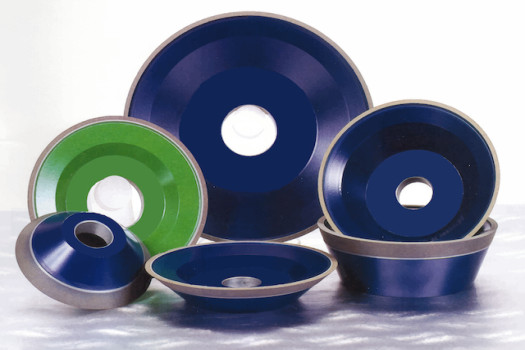
A CBN (Cubic Boron Nitride) grinding wheel is a superabrasive tool specifically designed for machining ferrous materials such as hardened steel. Moreover, manufacturers widely use CBN wheels for grinding hardened steel due to their excellent thermal stability.

Key Features:

  • High thermal resistance
  • Excellent wear resistance
  • Maintains sharp cutting edges
  • Ideal for high-speed grinding

Applications:

CBN wheels are widely used in:

  • Hardened steel grinding
  • Automotive components
  • Bearing manufacturing

They are commonly used with cylindrical grinding machines for achieving consistent accuracy and surface finish.

What is a Diamond Grinding Wheel?

A diamond grinding wheel uses industrial diamonds as abrasive particles and is best suited for non-ferrous and hard materials. In contrast, diamond wheels perform better when machining non-ferrous and brittle materials such as carbide and ceramics.

Key Features:

  • Extremely high hardness
  • Superior cutting ability
  • Ideal for brittle materials
  • Excellent dimensional accuracy

Applications:

Diamond wheels are used for:

  • Carbide tools
  • Ceramics and glass
  • Composites and non-metal materials

These wheels are often used in precision applications involving internal grinding machines, where high surface finish is required.

CBN vs Diamond Grinding Wheel (Key Differences)

However, selecting between CBN and diamond grinding wheels depends on the material and application requirements.

Feature CBN Wheel Diamond Wheel
Best for Ferrous materials (steel) Non-ferrous materials (carbide, ceramics)
Thermal stability Very high Moderate
Wear resistance High Very high
Chemical reaction with iron No Yes (not suitable for steel)
Surface finish Excellent Superior for hard materials

When to Use CBN vs Diamond Grinding Wheel

Use CBN Grinding Wheel When Working with Hardened Steel. Additionally, they Perform well in High-temperature Applications.:

  • Grinding hardened steel
  • High-temperature applications
  • Continuous production environments

On the Other Hand, Use Diamond Grinding Wheels for Carbide and Ceramic Materials.

  • Grinding carbide or ceramics
  • Non-ferrous materials
  • High-precision finishing applications

Selecting the correct wheel directly impacts surface finish. You can learn more in our detailed guide on improving surface finish in cylindrical and internal grinding. In contrast, the performance of diamond wheels differs significantly when used on non-ferrous materials.

Impact on Surface Finish

Both CBN and diamond grinding wheels play a crucial role in achieving fine surface finishes such as:

  • 0.4 Ra → Fine grinding finish
  • 0.2 Ra → High-precision super finish

When combined with optimized parameters and the right machine, these wheels help deliver consistent results. Our CNC Cylindrical Grinding Machines allow precise control of grinding parameters to achieve these finishes.

Machine Compatibility and Performance

The performance of grinding wheels also depends on machine capability. Therefore, using advanced CNC grinding machines ensures better control and consistency. At Elitech Machine Tools, we offer advanced grinding solutions designed for both CBN and diamond applications.

Explore our solutions across key industrial locations:

How to Choose the Right Grinding Wheel

When selecting between CBN and diamond grinding wheels, consider:

  • Workpiece material (ferrous vs non-ferrous)
  • Required surface finish
  • Production volume
  • Machine capability

Choosing the wrong wheel can lead to poor finish, higher wear, and increased costs. Additionally, proper grinding parameters improve consistency and surface finish in precision applications.

Conclusion

In conclusion, understanding the difference between CBN and diamond grinding wheels helps manufacturers make better decisions. Finally, selecting the right wheel based on material and application ensures optimal performance and surface finish.

  • Use CBN wheels for steel and high-temperature applications
  • Use diamond wheels for carbide and non-ferrous materials

At Elitech Machine Tools, we help manufacturers select the right grinding solutions to achieve superior performance and surface finish. Finally, choosing the correct grinding wheel ensures better productivity and longer tool life.

Looking for expert guidance or the right grinding machine?
Contact us through our Contact Page today.

FAQ (SEO Booster)

Q: Can diamond grinding wheels be used on steel?

No, diamond reacts with iron at high temperatures, leading to rapid wear.

Q: Why is CBN preferred for steel grinding?

CBN offers excellent thermal stability and does not react with ferrous materials, making it ideal for steel.

Q: Which wheel gives better surface finish?

Both can achieve excellent finishes, but the choice depends on the material being ground.

Grinding Wheel Dressing Tips: Improve Performance & Surface Finish

April – 2025

Grinding wheel dressing is a critical process for maintaining grinding efficiency, achieving superior surface finish, and extending wheel life. In modern manufacturing, proper dressing and truing techniques ensure consistent performance and precision.

At Elitech Machine Tools, we provide advanced grinding solutions designed to deliver high accuracy and optimal surface quality across industries.

What is Grinding Wheel Dressing?

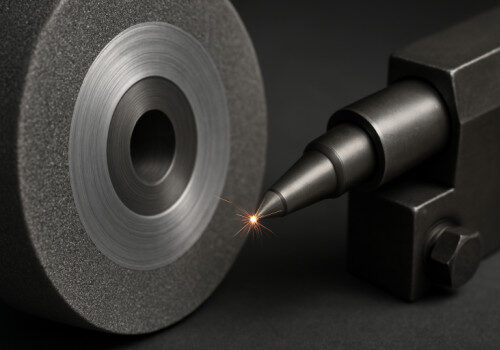
Grinding wheel dressing is the process of sharpening the wheel by removing dull abrasive grains and exposing fresh cutting edges.

Additionally, dressing helps:

  • Restore cutting ability
  • Improve surface finish
  • Reduce grinding forces

Proper dressing ensures the wheel performs efficiently in operations carried out on cylindrical grinding machines and other precision equipment.

What is Truing in Grinding?

Truing restores the shape and geometry of the grinding wheel.

In contrast to dressing:

  • Dressing sharpens the wheel
  • Truing corrects wheel alignment and roundness

Therefore, both processes are essential for achieving high accuracy and consistent grinding results, especially in CNC cylindrical grinding machines.

Importance of Grinding Wheel Dressing

Grinding wheel dressing directly impacts productivity and quality.

Moreover, proper dressing:

  • Improves surface finish
  • Reduces vibration and chatter
  • Enhances dimensional accuracy
  • Increases wheel life

As a result, manufacturers achieve better performance and lower operational costs.

To understand how dressing affects finish quality, read our detailed guide on
👉 improving surface finish in grinding.

Types of Dressing Tools

Selecting the right dressing tool is equally important.

Common Types:

  • Single-point diamond dresser
  • Multi-point diamond dresser
  • Rotary diamond dresser

Additionally, each tool offers different levels of precision and wear resistance depending on the application.

Grinding Wheel Dressing Tips (Best Practices)

Follow these practical tips to improve grinding performance:

Use Correct Dressing Parameters

Use appropriate feed rate and depth of cut. Lower values produce a smoother wheel surface.

Maintain Proper Dressing Frequency

Dress the wheel regularly to avoid loading and glazing.

Optimize Dressing Speed

Additionally, slower dressing speeds improve surface finish quality.

Ensure Proper Coolant Application

Coolant helps remove debris and prevents overheating during dressing.

Use the Right Dressing Tool

Select a suitable diamond dresser based on material and grinding operation.

Do’s and Don’ts of Diamond Dressing Tools

Do’s:

  • Use proper mounting and alignment
  • Maintain consistent dressing parameters
  • Inspect the dresser regularly

Don’ts:

  • Avoid excessive dressing depth
  • Do not use worn-out dressers
  • Avoid improper alignment

Machine Compatibility and Performance

Grinding performance depends not only on the wheel but also on machine capability.

Therefore, using high-quality machines ensures better results. At Elitech, our solutions support precise dressing and grinding operations, including:

Benefits of Proper Grinding Wheel Dressing

Proper dressing delivers multiple advantages:

  • Better surface finish (up to 0.2 Ra)
  • Improved grinding efficiency
  • Reduced machine vibration
  • Longer wheel life
  • Consistent dimensional accuracy

Finally, these benefits lead to higher productivity and reduced costs.

Conclusion

In conclusion, grinding wheel dressing plays a vital role in achieving precision, efficiency, and surface quality in grinding operations.

Additionally, combining proper dressing techniques with advanced machines ensures optimal results. At Elitech Machine Tools, we help manufacturers improve grinding performance with reliable and high-precision solutions.

Looking to improve your grinding process?
Get expert guidance through our Contact Page today.

FAQ

Q: What is grinding wheel dressing?

Grinding wheel dressing sharpens the wheel by removing dull grains and exposing fresh abrasives.

Q: Why is dressing important in grinding?

It improves surface finish, reduces vibration, and increases grinding efficiency.

Q: What is the difference between dressing and truing?

Dressing sharpens the wheel, while truing restores its shape and alignment.

Share Your Requirement • Discuss on WhatsApp Chat with Elitech about grinding machine requirement on WhatsApp
Send Your Requirement | Application | Drawing via Email