
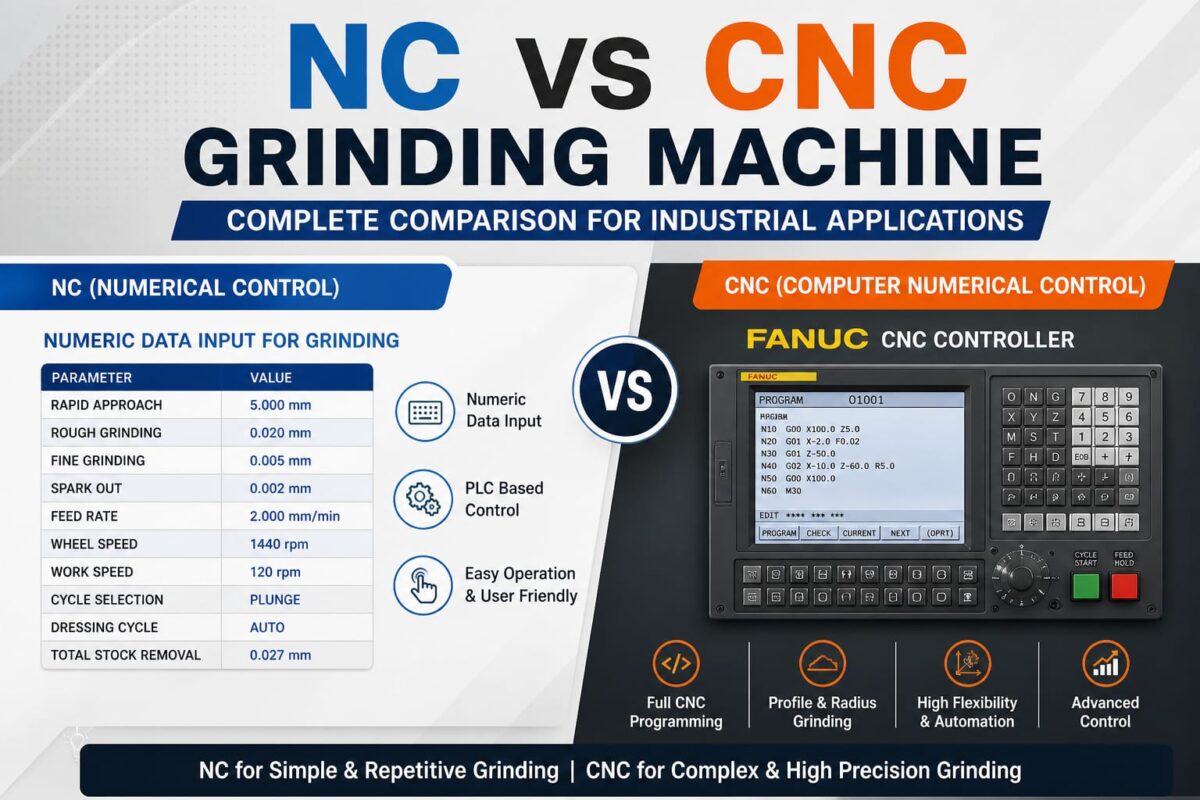
Choosing between an NC grinding machine and a CNC grinding machine depends on production requirements, operator skill, application flexibility, and automation needs. Both machine types deliver high-precision grinding performance; however, they differ in programming method, operation style, cycle flexibility, and application capability.
Moreover, This guide explains the complete difference between NC and CNC grinding machines for industrial grinding applications such as pump shafts, motor rotors, bearings, bushes, and precision engineering components.
What is an NC Grinding Machine?
An NC (Numerical Control) grinding machine operates through a PLC-based control system with touch pad HMI, servo motors, and drives. Operators enter numeric grinding values such as rough grinding, fine grinding, spark-out, and grinding cycle selection.
Additionally, NC grinding machines provide easy operation without requiring advanced CNC programming knowledge. The NC grinding machine operates through a high-end PLC and HMI automation technology with touch pad HMI, servo motors, and drives.
👉 Explore machine: NC Cylindrical Grinding Machine
What is a CNC Grinding Machine?
A CNC grinding machine operates through a fully programmable CNC controller system. The machine performs grinding operations according to stored programs and supports advanced grinding applications such as taper grinding, profile grinding, and radius grinding.
Moreover, CNC grinding machines provide higher flexibility and advanced automation for complex industrial applications.
CNC grinding machines commonly use advanced Siemens CNC controller systems for flexible grinding applications. Additionally, manufacturers also prefer Fanuc CNC controller systems for high-speed and critical industrial automation.
👉 Explore machine: CNC Cylindrical Grinding Machine
NC vs CNC Grinding Machine Comparison
| Feature | NC Grinding Machine | CNC Grinding Machine |
|---|---|---|
| Control System | PLC + HMI + Servo Drives | CNC Controller + Servo Drives |
| Operation | Easy and user-friendly | Requires programming knowledge |
| Programming | Numeric data input | Full CNC programming |
| Grinding Applications | Straight diameter grinding | Straight diameter and profile – radius foam grinding |
| Cycle Types | Plunge & oscillation | Plunge & oscillation |
| Cycle Switching | Easy switching mode through HMI | Program modification required |
| Flexibility | Up to 6 diameters in one setting | Unlimited program flexibility |
| Dressing Compensation | Auto compensation available | Auto compensation available |
| Profile Dressing | Straight wheel dressing | Radius/profile dressing possible |
| Manual/Semi-Auto Mode | Available | Limited |
| In-Process Gauging | Compatible | Compatible |
| Storage Capacity | Limited | High |
| Operator Skill | Low | Medium to high |
| Production Capacity | High | High |
Multi-Diameter Grinding Capability in NC Grinding Machine
The EMTU Plus Series NC Cylindrical Grinding Machine includes specially developed pre-programmed grinding logic. Therefore, the machine can grind up to 6 different diameters in a single setting regardless of diameter size or length.
Operators can separately select:
- Plunge grinding cycle
- Oscillation grinding cycle
for each individual diameter.
For example:
- 2 diameters can run in plunge grinding mode
- while 3 diameters can run in oscillation grinding mode
- within the same machine setting.
As a result, NC grinding machines provide excellent flexibility for repetitive industrial production without requiring complex CNC programming.
Plunge vs Oscillation Grinding Cycle Difference
Meanwhile, both NC and CNC grinding machines support plunge and oscillation grinding cycles.
However, NC grinding machines allow operators to instantly switch between cycles using a simple switching selection in the HMI touch panel.
In contrast, CNC grinding machines require separate programs or program modifications for changing grinding cycles.
Therefore, NC grinding machines offer easier shop-floor operation for repetitive jobs.
Radius & Profile Grinding Capability in CNC Machines
CNC grinding machines support radius and profile dressing through synchronous movement of machine axes.
As a result, operators can generate:
- Radius profiles
- Taper profiles
- Foam/track grinding profiles
- Complex wheel dressing shapes
Therefore, CNC grinding machines are highly suitable for:
- Bearing grinding applications
- Radius profile grinding
- Track grinding applications
Automation & Compensation Systems
Both NC and CNC grinding machines support:
- Automatic grinding compensation
- Auto dressing compensation
- Servo-controlled movement
- In-process gauging system compatibility
Additionally, manufacturers can integrate:
- Gantry-type auto loading unloading systems
- Robotic automation systems
- Mass production automation solutions
As a result, improve productivity and reduce manpower requirements.
👉 Learn more about productivity: Enhancing Productivity in Grinding Machines
Which Grinding Machine Should You Choose?
Choose NC Grinding Machine if you need:
- Easy operation
- User-friendly HMI control
- Straight diameter grinding
- Semi-auto flexibility
- Lower operator skill requirement
- Repetitive production jobs
Choose CNC Grinding Machine if you need:
- Radius or profile grinding
- Advanced automation
- Multiple grinding applications
- High flexibility
- Complex grinding cycles
Grinding Machine Applications Across Industries
NC and CNC grinding machines are widely used in:
- Pump industry
- Motor industry
- Bearing industry
- Automotive industry
- Precision engineering industries
👉 Related applications: Pump and Motor Grinding Applications
👉 Bearing applications: Bearing Grinding Machine Applications
Benefits of Modern Grinding Automation
Modern grinding industries require high productivity and dimensional consistency. Therefore, manufacturers increasingly prefer NC and CNC grinding machines for repetitive industrial applications. Additionally, automatic grinding compensation improves accuracy during long production cycles. Meanwhile, in-process gauging systems help reduce rejection and manual measurement. As a result, industries achieve better surface finish, lower downtime, and improved production efficiency.
Grinding Machine Supply Across India
We supply grinding machines across India for industrial applications.
- Grinding machine manufacturer in Gurugram
- Grinding machine manufacturer in Kolkata
- Grinding machine manufacturer in Rajkot
- Grinding machine supplier in Ahmedabad
- Grinding machine manufacturer in Mumbai
- CNC grinding machine supplier in Pune
- CNC grinding machine in Coimbatore
Why Industries Prefer NC and CNC Grinding Machines
Industrial manufacturers require stable production, accurate grinding performance, and easy machine operation. Therefore, many industries prefer NC and CNC grinding machines for repetitive and precision grinding applications. For example, pump shaft and motor rotor manufacturers use these machines for consistent dimensional control and surface finish.
Meanwhile, automatic grinding compensation helps operators maintain size accuracy during long production cycles. In addition, in-process gauging systems reduce manual inspection and minimize rejection. Consequently, manufacturers improve productivity while reducing downtime and operator dependency.
On the other hand, CNC grinding machines provide better flexibility for profile and radius grinding applications. Similarly, NC grinding machines offer easier operation and faster cycle switching for repetitive production jobs. As a result, both machine types remain highly popular in industrial grinding applications.
Additionally, modern grinding machines improve production flexibility and reduce manual intervention. Moreover, automatic compensation systems help operators maintain dimensional accuracy during repetitive grinding cycles. Meanwhile, in-process gauging systems reduce rejection and improve process stability. Consequently, manufacturers achieve better productivity, improved surface finish, and consistent grinding performance.
Practical Shop Floor Advantages
In many industrial applications, operators prefer simple and reliable grinding operation. Therefore, NC grinding machines help manufacturers reduce operator training requirements and improve production stability. Meanwhile, CNC grinding machines provide advanced flexibility for profile and radius grinding applications.
For example, pump shaft grinding applications usually require repetitive straight diameter grinding. In contrast, bearing and motor rotor applications may require profile grinding or multiple grinding cycles. Consequently, manufacturers select machine types according to production requirements and component complexity.
Moreover, automatic grinding compensation systems maintain dimensional consistency during long production runs. Similarly, in-process gauging systems reduce manual inspection and improve quality control. As a result, industries achieve better productivity, lower rejection, and stable grinding performance.
Contact Us for Grinding Machine Solutions
Looking for the right grinding machine for your industrial application?
👉 Contact Us for Grinding Solutions
Share your component drawing and production requirements for suitable machine recommendations.
FAQs – NC vs CNC Grinding Machine
NC machines operate through numeric data input and HMI controls, while CNC machines operate through fully programmed grinding cycles.
NC grinding machines are easier to operate because operators only need to enter basic numeric grinding values.
Yes, NC grinding machines can handle up to 6 different diameters in a single setting according to developed programming logic.
CNC grinding machines are suitable for radius and profile grinding applications.
Yes, both machine types support plunge and oscillation grinding cycles.
Yes, both NC and CNC grinding machines support in-process gauging systems.
NC grinding machines are highly suitable for repetitive production because of easy operation and quick cycle switching.
CNC grinding machines are better for complex profile, taper, and radius grinding applications.
Yes, both machines support automatic grinding compensation and loading automation systems.
